

The Shift from Generators to Battery Power on Australian Construction Sites
Contents
As battery-powered equipment becomes increasingly common on Australian construction sites, contractors are looking for new ways to deliver reliable temporary power without the noise, fumes and limitations of traditional generators. From civil infrastructure projects and tunnelling works to concrete coring and night works, portable battery power solutions are changing the way crews work on site.
The Shift from Generators to Battery Power
For decades, generators have been the go-to source of temporary power on construction sites. While they remain a common solution, many contractors are now looking for alternatives that reduce noise, eliminate fuel handling and provide safer operation in tunnels, confined spaces and urban environments.
At the same time, battery-powered tools and equipment have become increasingly common across the industry. As sites continue to adopt cordless technology, battery systems are emerging as a practical solution for powering equipment, charging tools and supporting temporary power requirements.
This shift isn't just about sustainability. It's about creating safer, quieter and more flexible worksites while reducing some of the operational challenges associated with traditional generators.
Why Battery Power Is Becoming More Common
Construction projects today face a range of challenges that didn't exist a decade ago. Noise restrictions, environmental requirements and increasingly complex project environments are forcing contractors to rethink how they power their sites.
Battery-powered solutions offer several practical advantages, including:
- Reduced noise compared to traditional generators
- Zero on-site emissions during operation
- Improved suitability for confined and enclosed spaces
- Lower maintenance requirements
- Reduced reliance on fuel storage and refuelling
These benefits are particularly valuable for contractors working in tunnels, rail corridors, urban environments, underground works and other projects where traditional generators can present operational challenges.
Why Civil Contractors Are Embracing Battery Power
One area where battery-powered solutions are gaining significant momentum is the civil construction sector.
From road upgrades and rail infrastructure projects to tunnelling and utility installation works, civil contractors often operate in environments where noise, ventilation and site access must be carefully managed. Many projects also involve night works or operations close to residential and commercial areas, where reducing noise can be a major advantage.
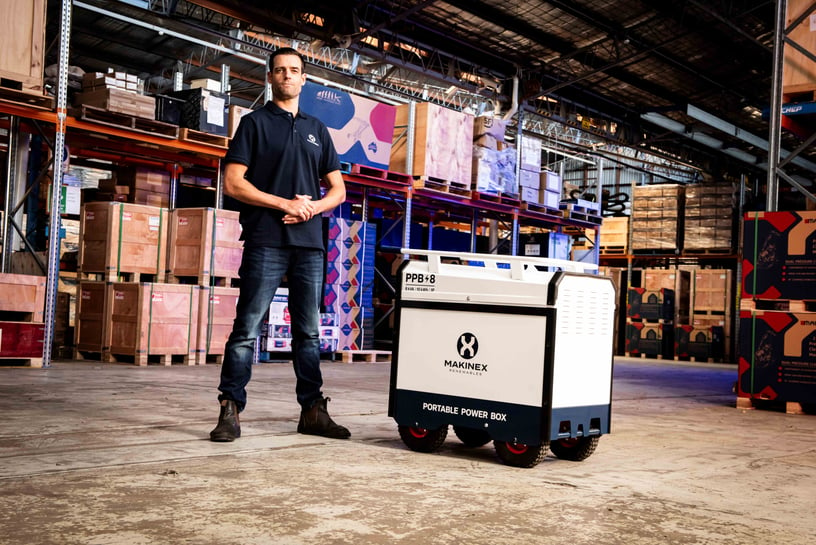
The Makinex Portable Power Box provides a practical alternative, allowing crews to access reliable power without many of the limitations associated with conventional generators.
As battery technology continues to improve, more contractors are recognising that battery power can be a viable option for a growing range of job site applications.
The Makinex Portable Power Box in Action
The Makinex Portable Power Box has been developed to provide contractors with a portable, battery-powered alternative for temporary power applications.
Providing quiet, emission-free operation, the Portable Power Box is particularly well suited to environments where noise reduction, site safety and operational flexibility are important considerations.
The unit has proven effective across a range of applications, including concrete coring, civil construction works, tunnelling projects and other situations where access to temporary power is required without the drawbacks of a traditional generator.
Real-World Performance: Concrete Coring Trials
To evaluate the performance of the Portable Power Box in demanding construction applications, Construction Sciences conducted a series of concrete coring trials across multiple concrete types.
The trials included:
- High-strength aircraft base concrete
- R83 concrete base
- R82 lean mix concrete subbase
The results demonstrated the capability of battery-powered solutions to support demanding construction activities.
During testing of high-strength aircraft pavement, the Portable Power Box powered both the core drill and vacuum while consuming only 10% of the available battery capacity for three 110 mm diameter cores. Based on these results, the system demonstrated sufficient capacity for up to 30 aircraft pavement cores.
Testing on R83 concrete produced similarly impressive outcomes, with the Portable Power Box demonstrating the potential to support up to 60 cores under comparable operating conditions.
These results highlight the growing capability of modern battery-powered systems and demonstrate that many applications traditionally powered by generators can now be supported by portable battery technology.
What the Future Looks Like for Construction Power
While generators are expected to remain part of the construction industry for many years to come, battery-powered solutions are rapidly becoming a valuable addition to the temporary power landscape.
As contractors continue adopting cordless tools and seeking safer, quieter and more flexible ways of working, the demand for portable battery energy storage systems is expected to grow.
For civil contractors, construction crews and specialist trades alike, battery-powered solutions offer a practical way to reduce noise, improve site flexibility and support modern construction practices.
The shift from generators to battery power is already underway, and as technology continues to advance, portable battery systems are set to play an increasingly important role on Australian construction sites.